Active Shape Models with Stasm


Stasm is a C++ software library for finding features in faces.
You give it an image of a face and it returns the positions of the facial features.
Stasm is based on the Active Shape Model of Tim Cootes and his colleagues.
Stasm is designed to work on front views of faces with neutral expressions.
It performed very well in an independent 2013
comparative study.
Source code is provided under a BSD style license.
OpenCV is required.
Source code example.
Wasm utility
to try out Stasm on a Windows system.
(This can be easily uninstalled by running the included
uninstaller, or from "Control Panel | Add or Remove Programs",
leaving no trace on your system.)
Download
There are basically two variants of Stasm.
The latest version of these variants is given below.
- Version 4.1.0
is the latest version.
It was released on Dec 27, 2013.
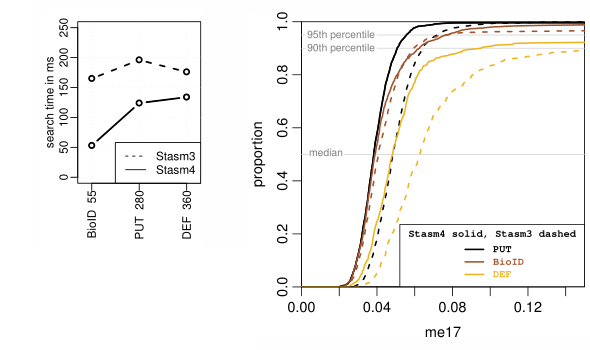
It is faster and gives better fits than Version 3.1
(see graphs to the right).
- Version 3.1
was the previous well-known major variant.
It is what you see cited in papers before 2014.
It is included here mainly for historical interest.
Documentation
Main documentation:
Other documentation:
Citing Stasm
Please cite either the Stasm
paper
or
thesis
in any publicly available text that uses Stasm.
The BibTex entries for these documents are
@article{Milborrow2014,
  author={S. Milborrow and F. Nicolls},
  title={{Active Shape Models with SIFT Descriptors and MARS}},
  journal={VISAPP},
  year={2014}
}
@book{MilborrowThesis2016,
  author={S. Milborrow},
  title={{Multiview Active Shape Models with SIFT Descriptors}},
  publisher={Doctoral Thesis. University of Cape Town (Department of Image Processing)},
  year={2016}
}
Note that our 2008 ECCV paper no longer applies to this version of Stasm.
Acknowledgments
I would like to thank the following people who provided ideas, code, data, and techniques used in Stasm.
- Juan Cardelino for his make files
- Tim Cootes
- David Cristinacce
- Eugen Dedu for his line drawing code used in earlier versions of Stasm
- M. Galassi, J. Theiler, and others for the GSL library used in earlier versions of Stasm
- Rob Hess for his opensift library
- GuoQing Hu for his start-shape alignment technique and his Android port
- O. Jesorsky, K. Kirchberg, and R. Frischholz for the BioID data.
The face at the top right of this web page is from the BioID set.
- David Lowe the inventor of SIFT
- Aleix Martinez and Robert Benavente for the AR database
- Darren Murray and his team for high quality manual landmarking
- Ramin Nakisa and others for gslwrap used in earlier versions of Stasm
- Fred Nicolls
- Developers and contributors to the OpenCV library
- Henry Rowley, Shumeet Baluja, and Takeo Kanade
for the Rowley face and eye detector used in earlier versions of Stasm
- Mikkel Stegmann
- Oliver Walker, Elizabeth Walker-Watts, and Gill Andrew for MUCT landmarking
- Roger Willcocks for his prototype ASM code
- Yan Wong at Bang Goes The Theory
- The XM2VTS people at Surrey for the XM2VTS database
- Brad Yearwood and Pierre Moreels for help with the original Ubuntu port
- The following people also contributed in one way or another. Thanks guys!
Anton Albajes-Eizagirre,
Peter Anderson,
Daniel Lelis Baggio,
Christian Baumberger,
Andew Berend,
Tom Bishop,
Mohamed Bouras,
Omar Cavagna,
Sai Chaitanya,
Mark Chen,
Radke Chinar,
Samuel Clark,
Wang Dayong,
Elliott Dicus,
Philippe Dreuw,
Dave Durbin,
Silam Abd Elfattah,
Martin Etchart,
Arnaud Gelas,
Allen Gordon,
Moti Hamo,
Yu Hang,
Paul Harper,
Sean He,
Bartlomiej Hyzy,
T.S. Karthikeyan,
Voung Le,
Ryan Lei,
Tamas Lengyel,
Ying Li,
We-Chao Lin,
Satish Lokkoju,
David Daniel Macurak,
Jaesik Min,
John Morkel,
Ghulam Muhammad,
Alka Nair,
Svetoslav Nedkov,
Brett Oberman,
Alexander Petrov,
Sebastien Piccand,
Tony Polichroniadis,
Simon Prince,
Raymond Ptucha,
Yiming Qian,
Ham Rara,
Gianpaolo Repici,
David Ricardo,
Chris Ritchie,
Sheerko Hma Salah,
Jason Saragih,
Lakshmiprabha Nattamai Sekar,
Lei Shi,
Seyedehsamaneh Shojaeilangar,
Gagandeep Singh,
Abhi Sinha,
Nirin Suarod,
Yunlian Sun,
Phyliss Thomas,
Andy Wang,
Xuezhong Wang,
Mark Williams,
Jian Yao,
Kotaro Yasuda,
Hao Zhang,
Hao Zhou,
and
Tianmin Zou.
Back to Stephen Milborrow Homepage